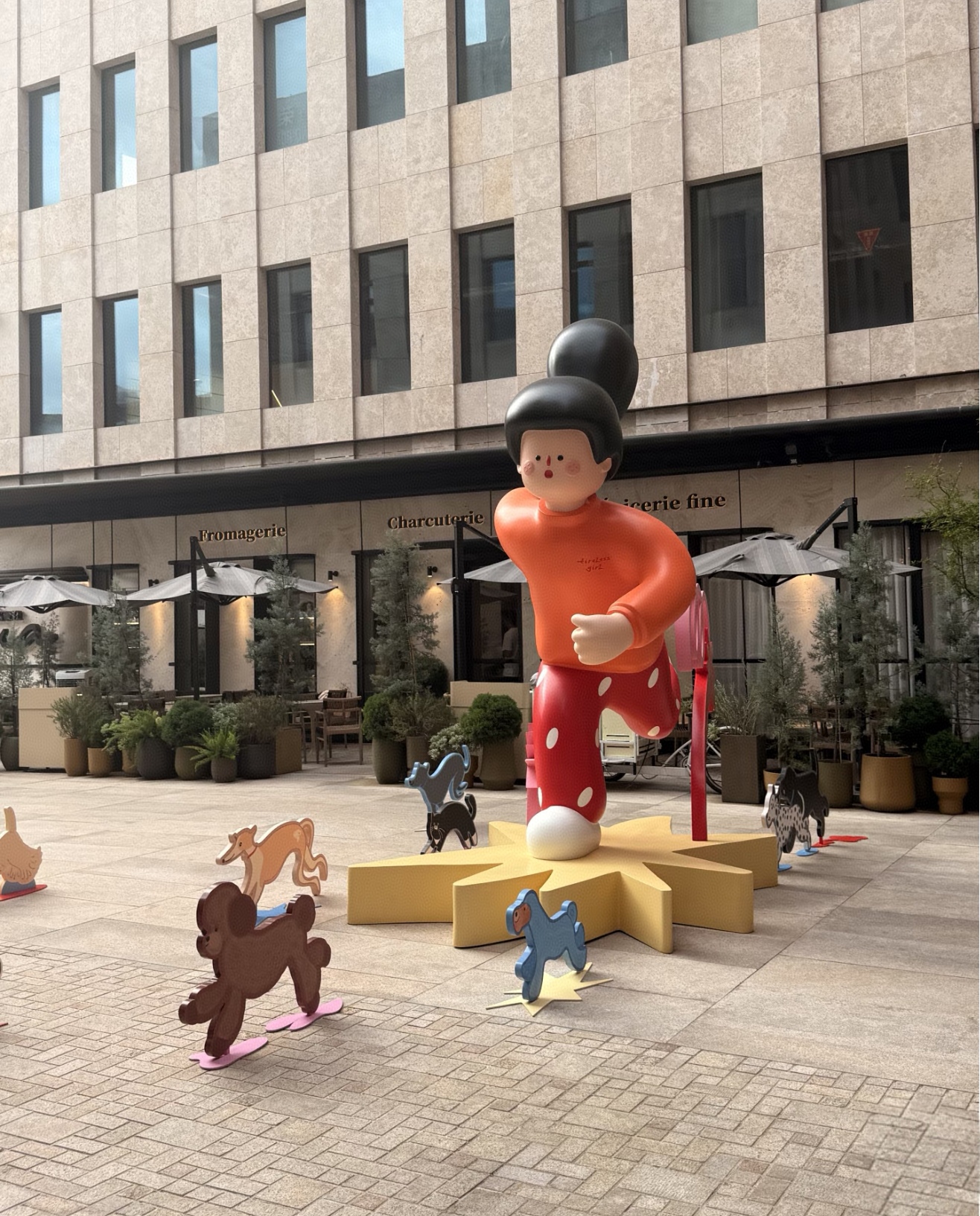
How Landmark Sculptures Can Strengthen Storefront Branding
A landmark sculpture can give a bakery, shop or public destination a distinctive physical identity. Its value depends on more than size: people need to notice it, connect it with the right brand and remember that connection. Here is what consumer research can tell us—and how to evaluate the results at a real location.
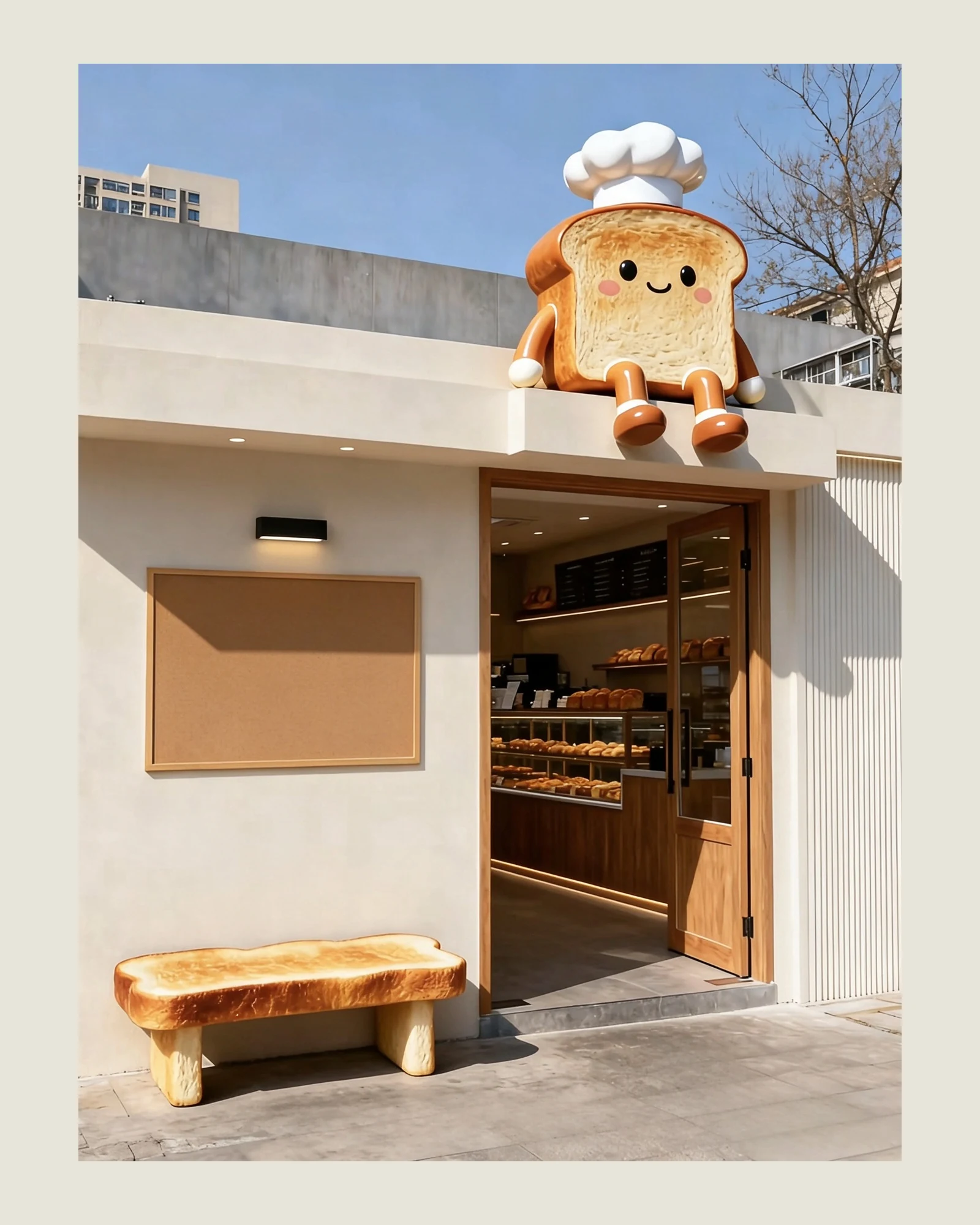
For a bakery on a busy street, the first marketing challenge happens before a customer tastes the bread: getting noticed and understood. A sculptural loaf, a character or another distinctive landmark can be designed to communicate the business’s identity at that moment.
The commercial question is not simply whether the sculpture looks impressive. It is whether people connect the object with the bakery, feel comfortable approaching the entrance and remember the business afterward. Those are different outcomes, and a professional design brief should keep them separate.
What market research says about storefront visibility
In July 2026, The Harris Poll surveyed 2,007 U.S. adults aged 18 and older on behalf of Signarama. The online survey examined business signage, including its relationship with recognition, trust and reported customer behavior.[1] [2]
| Marketing consideration | Reported survey finding | How to read the number |
|---|---|---|
| Business memory | 93% said a business’s signage impacts whether they remember the business. | A share of respondents reporting an influence—not a 93% improvement in recall. |
| Standing out | 91% said signage impacts a business’s ability to stand out from competitors. | Perceived influence on differentiation—not a measured increase in visual impact. |
| Perceived quality | 90% said signage impacts whether they view a business as professional or high-quality. | A perception finding—not proof that the products are better. |
| Trust | 82% said signage impacts their trust in a business. | Reported influence on trust—not an 82% increase in friendliness or liking. |
| Store discovery | 39% said they had entered a business solely because of its sign. | A reported past experience—not a forecast of additional visitors. |
| Visual clutter | 79% agreed that businesses with too many signs can create confusion. | A reminder to coordinate visual elements rather than simply add more. |
Source: Signarama / The Harris Poll, 2026; findings reported in the original September 8 release. This was industry-commissioned research about signage, not an experiment comparing storefronts with and without sculptures. The published methodology reports a Bayesian credible interval of ±2.7 percentage points at the 95% confidence level for the overall sample.[1] [2]
These findings provide a useful market context: consumers report that physical business identifiers matter. They do not establish how much a particular sculpture will improve a bakery’s performance. A sculpture should therefore be considered alongside the storefront name, entrance, lighting and display—not as a replacement for clear identification.
A memorable object must point to the right business
A visitor may remember “the giant bread sculpture” without remembering the bakery’s name. That is object recognition, not necessarily successful brand communication.
Research by Warlop, Ratneshwar and van Osselaer examined how distinctive brand cues help consumers connect earlier product experiences with the correct brand. In a juice-tasting experiment, differentiated packaging colors improved the accuracy of later quality judgments compared with visually identical packaging. Evidence for shape differences on that same accuracy measure was weaker.[3]
The practical design implication is to connect the landmark with consistent brand cues. For a bakery, that might mean a recognisable bread form, a palette already used by the business and a clearly visible name nearby. This is an application to explore, not a storefront result demonstrated by the packaging experiment.
The useful test is not just “Do you remember this sculpture?” It is also “Which business does it belong to?”
A friendly character needs to fit the brand
Giving an object a face does not automatically make it more appealing. Expression, posture and the identity being communicated all matter.
Aggarwal and McGill studied how people evaluate products with human-like features. In one experiment involving 122 university students, a smile-like car grille received a higher average product-evaluation score than a frown-like version when the car was presented as a human spokesperson: 4.59 versus 4.14. The difference was not statistically significant when the car was presented simply as an object.[4]
These were product-evaluation scores, not percentages of brand liking or approachability. The experiment suggests that human-like features work in context; it does not show that every smiling sculpture will improve customer sentiment.
For a bakery, a relaxed character with an expression that fits a welcoming identity is a reasonable design hypothesis. An aggressive pose or a form that blocks the doorway may communicate something else. The decision should follow the intended audience and brand character, rather than an assumption that every business needs a mascot.
Translate the idea into a bakery or place brief
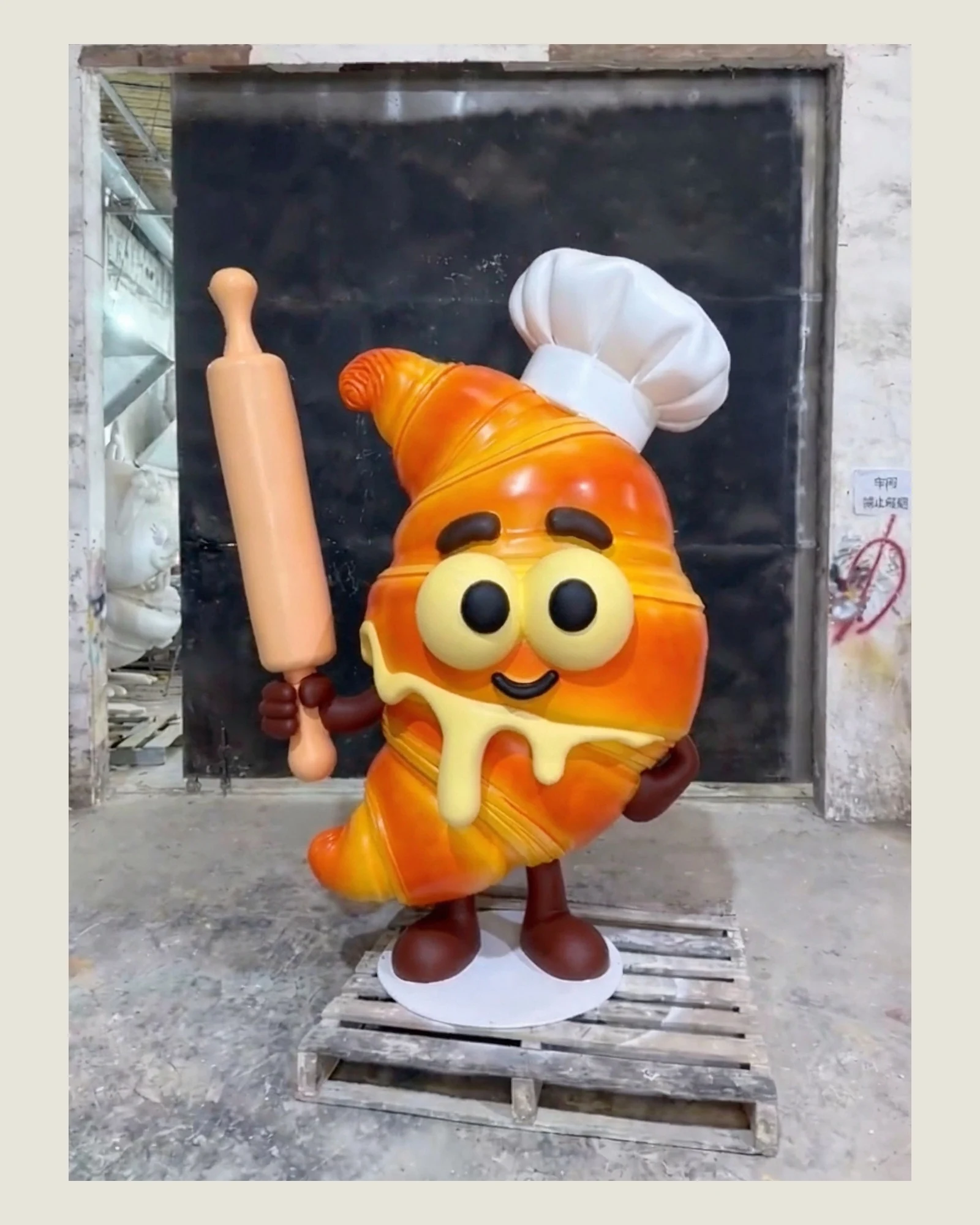
Consider a hypothetical independent bakery that wants a recognisable entrance landmark. The brief could define three jobs: make the storefront easier to identify, express the bakery’s character and give visitors a clear visual reference for the location.
The sculpture should remain connected to the actual product or story. A bread-inspired form can be appropriate if bread is central to the business. A borrowed character with no connection to the brand may attract attention without helping people understand the shop. Rights to any character or other protected artwork also need to be confirmed.
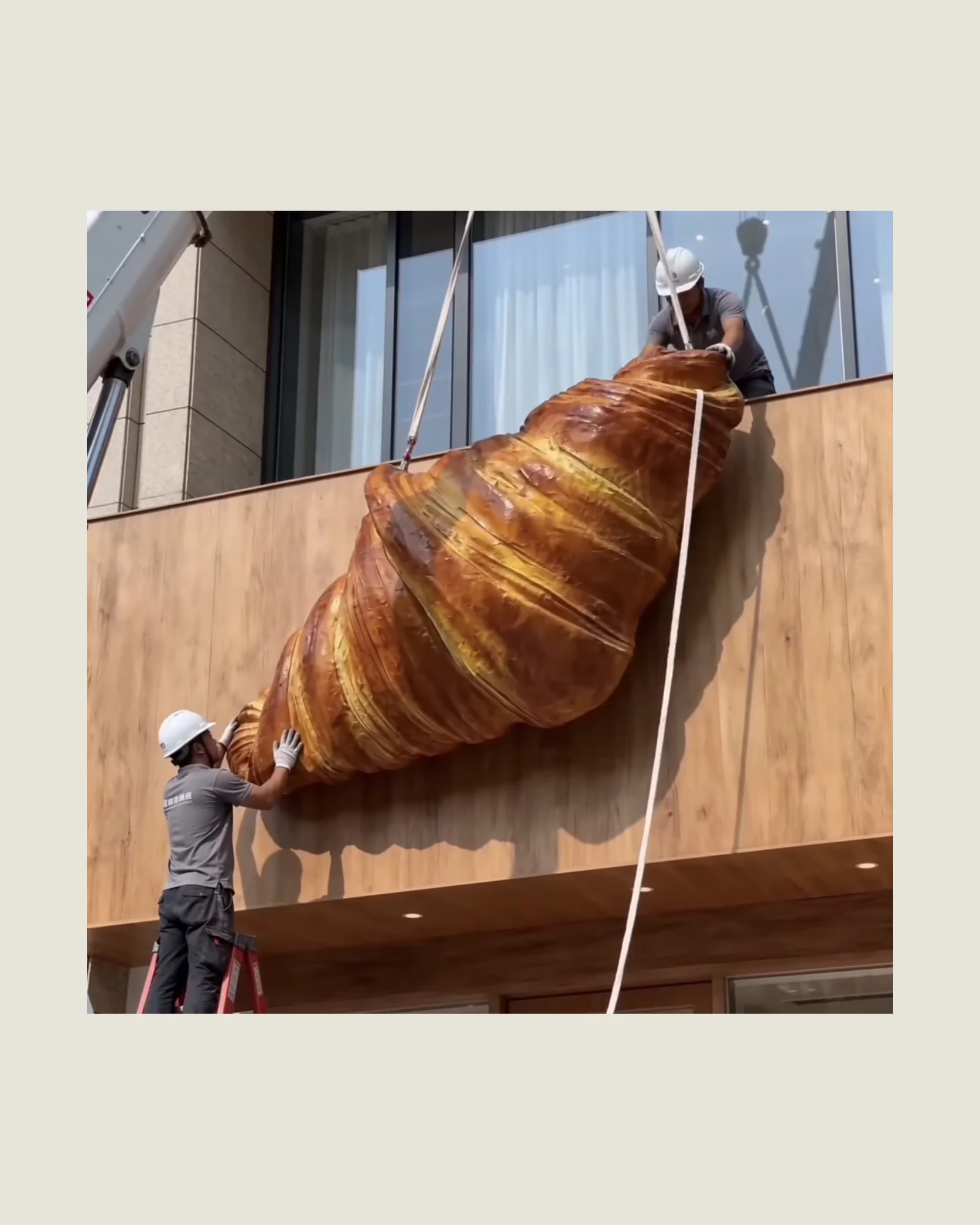
Positioning deserves as much attention as the object. Review the main pedestrian viewing angle, visibility of the business name and space around the entrance. Leave accessible routes clear. A possible photo position should not force visitors into a doorway or vehicle route, and a decorative sculpture should not be presented as seating or play equipment without the appropriate design review.
For a cultural park or neighborhood destination, the same planning question changes from “Which shop is this?” to “What makes this place recognisable?” A coherent visual identity is the objective—not a guaranteed popularity increase across the whole area.
Nexaform’s Fireless Girl × Cultural Park project offers a visual reference for character forms within a shared setting. It is not presented here as a measured uplift study.
Measure attention, liking and memory separately
There is no defensible universal percentage in the research reviewed here for how much a bakery sculpture increases liking, approachability, recall or visual impact. Those outcomes need a clear definition and a location-specific comparison.
| Intended benefit | A practical measure | What the result would tell you |
|---|---|---|
| Positive brand impression | Percentage choosing the top two answers on the same five-point “overall impression of this bakery” question. | Whether the measured share expressing a positive impression changed. |
| Approachability | Percentage choosing the top two answers on “this bakery feels welcoming.” | Whether the storefront feels more welcoming—not whether everyone actually enters. |
| Brand memory | Percentage correctly naming the business without a prompt after a fixed interval, such as 24 hours. | Whether people remember the business, rather than only the sculpture. |
| Visual attention | Percentage of observed passersby who stop to look, using a predefined stopping rule and time window. | One operational measure of attention—not a universal “visual impact score.” |
| Store entry | Entrants as a percentage of passersby observed during comparable trading periods. | Whether entry behavior changed; sales still require separate measurement. |
Use the same questions, viewing conditions and measurement periods before and after installation. Keep observation anonymous and surveys voluntary. Record changes in weather, promotions, trading hours or pedestrian traffic that could affect the comparison. A similar unchanged location, where available, can help distinguish a general market change from a site-specific change; a simple before-and-after comparison alone does not prove causation.
For example, if measured recall changes from 24% to 33%, that is an increase of 9 percentage points, or 37.5% relative to the original rate. This is an illustrative calculation only—not a research finding, a Nexaform result or an expected sculpture outcome. A published result should also state its sample size and uncertainty.
The strongest landmark brief connects visual identity with a measurable purpose. A sculpture may be worth considering because it helps communicate what a place is and gives people a distinctive cue to remember it by. Its success should be judged against those objectives, not an unsupported promise of a fixed percentage gain.
If you are planning a branded landmark, share the storefront, brand references and intended customer experience with Nexaform on WhatsApp to discuss a project brief.
References
- Signarama — The Sign Effect: 2026 Consumer Signage Survey, conducted by The Harris Poll
- Signarama — Original September 8, 2026 survey release and methodology
- Warlop, Ratneshwar and van Osselaer, 2005 — Distinctive brand cues and memory for product consumption experiences, university repository full text
- Aggarwal and McGill, 2007 — Is That Car Smiling at Me? Schema Congruity as a Basis for Evaluating Anthropomorphized Products, author-uploaded full text
Your project, in context
Ready to discuss your space?
Share your project brief or reference images with our team. We will help identify the next practical step.
Discuss your project on WhatsApp ↗Continue exploring